Although still in its infancy, AI has already drastically changed the way almost all businesses operate today. We’re still nowhere near the levels of Skynet or HAL (probably – no one can accurately predict if, and when, we’ll make a breakthrough that leads to the creation of an entirely self aware artificial intelligence), but the impact AI is having on businesses is already significant.
You’ve probably seen AI in action without even noticing it directly – the way your social media knows what adverts to show you based on your browsing history is just one example. From assembly lines to social media advertising, database management to automated chat bots, AI is quietly at work streamlining processes for businesses large and small across the globe.
Just as with other sectors, AI has started making major headway when it comes to recruitment solutions in the last few years. Most industry professionals agree it will have an even more significant impact on the sector in the near future as well.
While this doesn’t necessarily mean you’ll be sharing an interview panel with Johnny Five or ED-209, it does mean there could be some major changes on the horizon for recruitment and HR professionals.
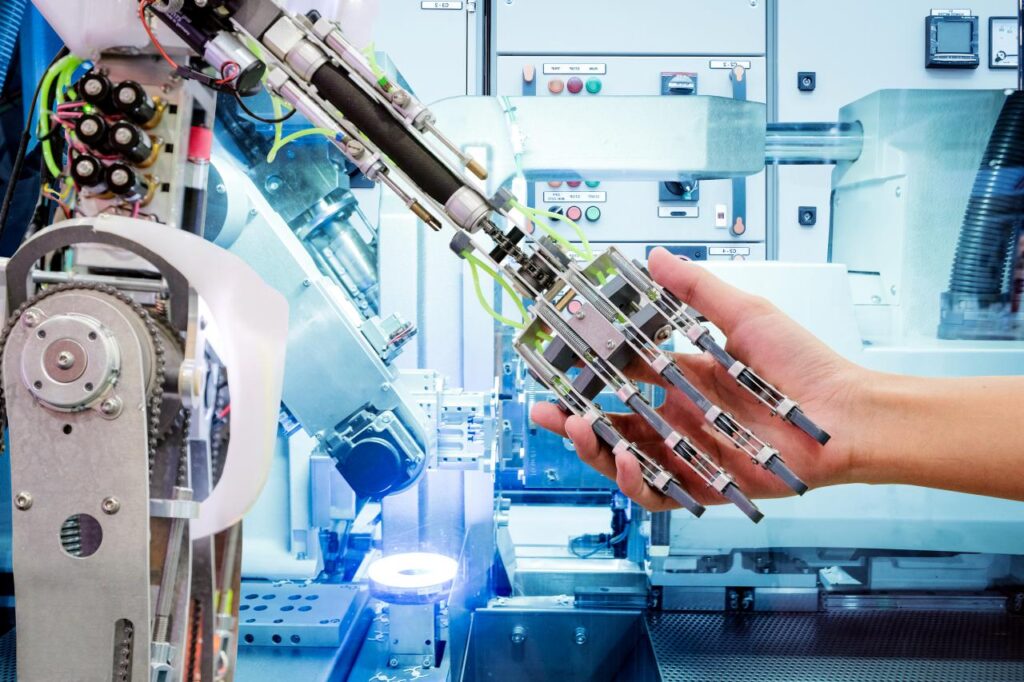
Ultra Search and Source
Most recruiters are familiar with applicant tracking systems. These make any HR professional or recruiter’s job much easier and less time consuming, as they keep candidate data and applications neatly organised with no risk of human error.
The next, and most recent step in the optimisation of this process is automated candidate sourcing. While most ATS software has had the ability to trawl online CVs for some time, newer applications can use natural language processing and more advanced AI to search millions of online CVs extremely quickly and accurately. Many applications can now even get in touch with potential candidates directly to get the ball rolling.
This means that the often time consuming job of sourcing candidates could soon be a thing of the past for human recruiters. At the very least, more time can be spent on comparing top candidates for roles, rather than sorting out front runners manually.
Goodbye to Bias
Unfortunately, as humans we tend to come with, and develop, a number of biases. What’s worse, any such bais can manifest almost entirely unconsciously. Something as small as a surname, where an applicant studied, or what they do in their free time could sway an interviewer’s decision at the last minute.
There are already a number of AI driven solutions to this problem available for recruiters. These include things like chatbots and pre interview assessment software that are configured to avoid bias and promote diversity. There’s even software available that helps recruiters write a job posting using language that’s more inclusive. These options help ensure that diversity is maintained early on in the process, and that candidates aren’t filtered out due to any recruiter bias, deliberate or otherwise.
Some larger multinationals are already using similar AI solutions to completely eliminate any potential for discrimination during the hiring process. One such example is a smartphone game that’s specially designed to measure a candidate’s mental and emotional aptitude only, bypassing any potential bias due to gender, race, or anything else.
Companies that have implemented these practices have already reported a huge increase in diversity for their applicants. It’s clear that AI already makes the hiring process fairer from the outset, so it’s certainly something we can expect to see more of.
Expression Analysis
Facial recognition and expression analysis aren’t to everyone’s taste, but it’s hard to argue with their potential when it comes to assessing a job interview (maybe ED-209 will be on the panel after all).
Some currently available software can identify how effectively a person might deal with a role, purely based on their video interview footage. The software analyses a candidate’s answer, along with how quickly they responded to the question, and uses AI to determine their potential effectiveness in the role. It can also spot emotional cues in facial expressions, which is also factored in to the overall assessment.
There is a danger that such systems could place even more pressure on candidates of course, and no one is currently relying on these systems exclusively – human interviewers are still the most important part of the process.
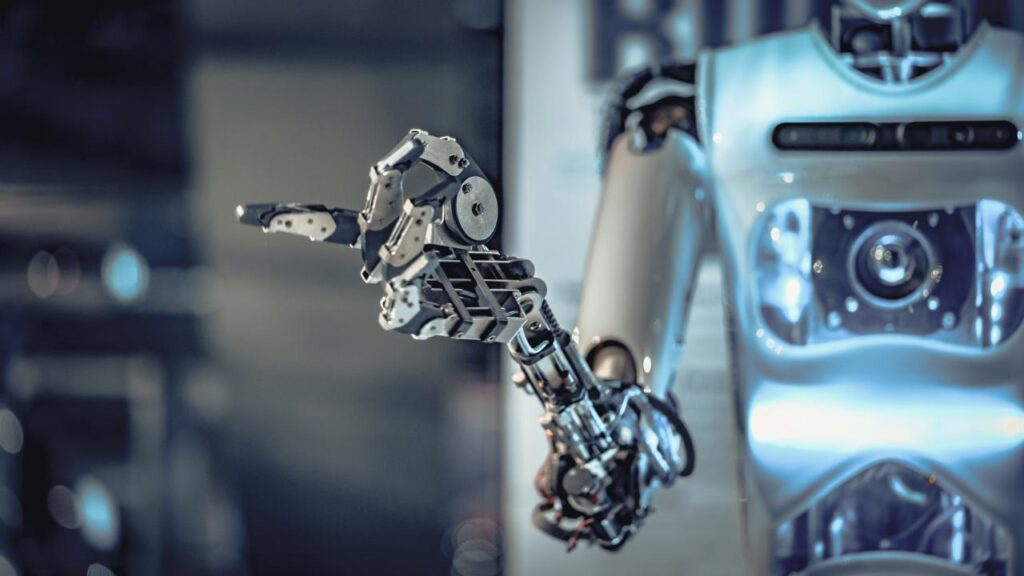
Precision Personalisation
We’ve touched on a few innovate AI solutions already available today, but what’s potentially around the corner is even more game changing. AI could be used to drastically increase the level of personalisation that candidates receive, for example.
Recruiter chat bots could learn about a candidate from their CV, past experience, and previous communications, delivering messages that are more personal to each individual jobseeker, as well as further automating the entire sourcing and CV matching process.
The same could be true for Employee Value Propositions. Today, these are generic benefits to all employees, no matter what their role might be. AI could learn about each individual in a company, before being able to provide a customised EVP program tailored to each employee. It could also manage this data, and modify it as needed based on the effectiveness and popularity of various EVPs.
People Power?
In summary then, it does seem that almost all the framework is in place for a fully AI/robot driven recruitment process from start to finish. Advanced ATS software can be used to source a potential candidate and make initial contact. Chatbots can then keep the candidate aware of each stage of the recruitment process, as well as detail the time and date of any interview. A video interview can be conducted, which allows AI to get a better understanding of the capabilities of the candidate, before all the information is collated and sent through to an AI that rates the entire candidate journey, before sending an offer or rejection letter.
One area this all overlooks of course, is the importance of human interaction. No matter how unbiased and efficient AI might be in terms of finding the best candidate, it creates a few problems of its own. Candidates could feel alienated experiencing a fully automated process, and there are already concerns from some about AI deciding their employment fate.
Is AI making the jobs of recruiters easier? Absolutely. Is AI likely to replace all human recruiters in the near future? Unlikely. In the end, even if AI delivers a fully optimised recruitment process from start to finish, it could come down to simple perception: People are still likely to prefer dealing with people. Not only that, human beings are still ahead of AI when it comes to dealing with unpredictable situations. So far at least.
If you’re currently looking for talented applicants, or planning on posting a new job, check out how JobLookup could help you as an employer or recruiter.
People Also Read

Over the past two decades, DEI has steadily moved up the agenda for UK employers. While it was initially a response to equality legislation, DEI …

While salary, benefits, and career advancement opportunities are still important to UK jobseekers, they’re no longer the only driving factors. More and more candidates want …

Social wellbeing refers to the quality of our social networks and interactions and how connected we feel to other people. Since most people spend most …
... what-you-need-to-know for more information. Artificial intelligence can be ...
... No-code/low-code tooling (Zapier, Make) AI AI AI artificial Intelligence l...
... , operational excellence, and the adoption of emerging technologies, includ...
... redesigned. Setup collaboration rhythm with Digital Intelligence, Investme...
... redesigned. Setup collaboration rhythm with Digital Intelligence, Investme...
... in technology and a genuine passion for artificial intelligence to play a ...
